

Why Payout Settings Are Moving Into Business Suite ?
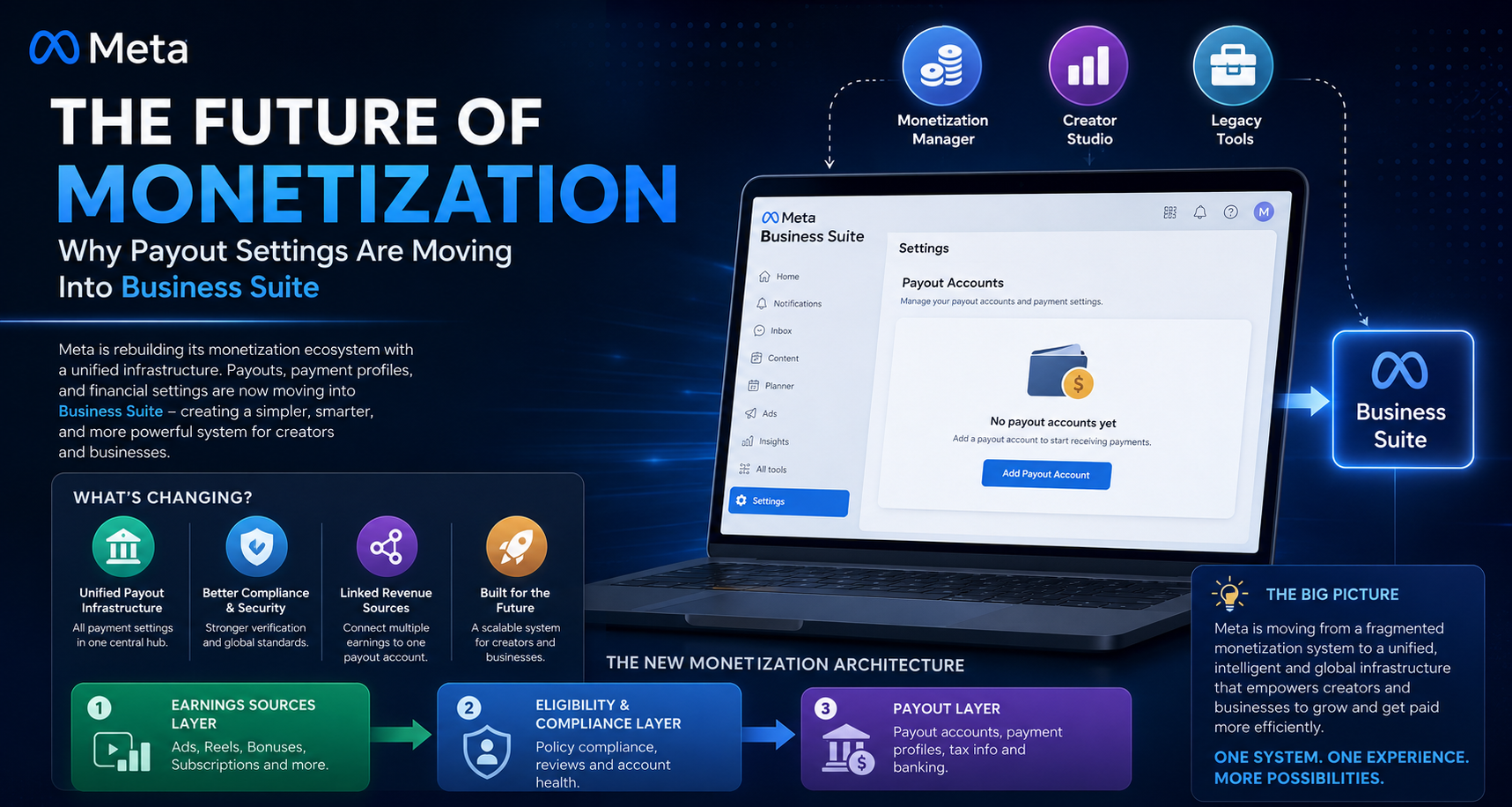
In recent years, Meta has been gradually implementing a deep structural transformation in its monetization ecosystem. This shift is not limited to interface updates or dashboard changes it reflects a complete redesign of how earnings, payments, and monetization tools are organized across the platform.
One of the clearest indicators of this transition is the emergence of new endpoints and settings paths within Meta Business Suite, such as:
/latest/settings/payout_accounts
These pages did not previously exist in this form within legacy systems like Monetization Manager or Creator Studio, signaling a broader infrastructure shift.
From Fragmented Tools to a Unified System
Historically, Meta’s monetization tools were distributed across multiple separate products, including:
- Monetization Manager
- Creator Studio
- Audience Network
- Instant Articles
- Separate payout and payment settings per product
This fragmented structure created operational complexity, especially when managing multiple revenue streams across different platforms.
Meta is now moving toward a unified model known as:
Unified Monetization Infrastructure
This approach consolidates monetization management into a more centralized and scalable system.
What Is Actually Being Moved Into Business Suite?
The most visible part of this transformation currently involves the payout layer, which is being migrated into Business Suite.
This includes:
- Payout Accounts
- Payment Profiles
- Tax and compliance information
- Linking multiple revenue sources to a single financial identity
Instead of being scattered across different tools, these financial components are now increasingly managed inside Business Suite.
This shift positions Business Suite as the central hub for financial operations within Meta’s ecosystem.
What About Audience Network and Instant Articles?
Not all legacy monetization products are being migrated into the new system. Some have already been phased out entirely, including:
- Audience Network: Gradually discontinued and significantly reduced in scope
- Instant Articles: Officially shut down as a standalone monetization product
These are not being transferred into the new infrastructure; instead, they are part of Meta’s broader product sunset strategy.
How the New Monetization Architecture Works
Meta’s emerging monetization system can be understood as a three-layer architecture:
1. Earnings Sources Layer
This includes all revenue-generating products such as ads on videos, reels monetization, and performance-based bonuses.
2. Eligibility & Compliance Layer
This layer determines monetization access based on policy compliance, account standing, and review systems.
3. Payout Layer
This is the financial backbone of the system, now increasingly centralized within Business Suite, handling payment processing, bank connections, and payout distribution.
Why Meta Is Making This Change
Several strategic motivations are driving this transition:
- Reducing fragmentation across legacy monetization systems
- Improving global payout infrastructure efficiency
- Unifying the experience for creators and businesses
- Building a scalable foundation for future AI-driven and content-based monetization models
What This Means for Creators and Businesses
This transition does not immediately change earnings or eligibility policies, but it does introduce structural and operational changes, including:
- Gradual relocation of financial settings into Business Suite
- Changes in where payout configurations are managed
- Temporary empty or incomplete interfaces during migration phases
- Consolidation of multiple financial tools into a single system
These are typical signs of an ongoing backend migration rather than a fully deployed product release.
Conclusion
What is happening inside Meta is not a simple UI update, but rather:
A complete restructuring of the monetization stack
The company is progressively dismantling its legacy monetization infrastructure and replacing it with a unified system centered around Business Suite as the primary financial and operational hub.
While the transition is still in progress, the direction is clear:
Meta is moving toward a fully integrated monetization ecosystem designed for scalability, simplicity, and long-term stability.
